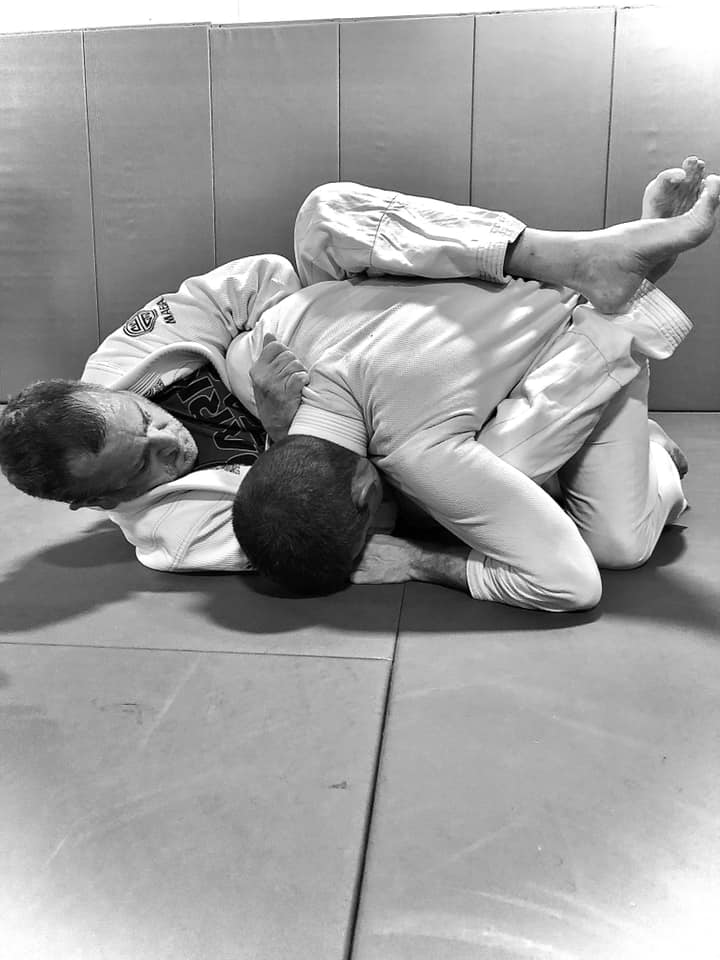
The chaos of a life or death struggle, especially at hand-to-hand combat range, can be mentally overwhelming. In a grappling encounter , this chaos level goes up exponentially. The better the skill set, the less this occurs, but what about for that person who is still learning to fight under in-extremis duress?
Keep this checklist in mind, and follow it when you don’t know what the next step is.
1) Breathe – this sounds like a “duh”, but under stress , most especially in grappling, this is about the first thing that falls apart. Either we stop breathing entirely, or we hyperventilate. Both ways mean we can get the right amount of oxygen into our body the needed way. Focus on forced exhalation. The following inhale tends to follow correctly after a good and powerful exhale.
2) Move Your Hips – You May rightly ask “how”, and the answer is that it does not matter. Moving the core and the main driver of leverage (which are what the hips are) leads to some movement which makes correct movement easier are more likely.
3) Underhook, underhook, underhook – The underhook is everything in grappling, whether standing, on the ground underneath an attacker, or on the ground on top of an attacker, the underhook takes care of so much. Get the underhook and keep the underhook, and a path to winning becomes visible regardless of position.
There are a lot of things to remember about what we have to do in Brazilian Jiu-jitsu. Hundreds of techniques, different positions, thousands of counters, a large number of principles and concepts that we have to be doing at all times; in short, a long list of things to not forget, and all of it can be altered in the blink of an eye by what our partner does. It can be daunting, especially to the beginner, thinking about all of this and trying to figure out how we are going to remember any of it in the heat of the moment all while another person is trying to choke us into unconsciousness.
There are a number of mantras that try to help us put this into understandable chunks. Perhaps the most famous in Jiu-Jitsu is “position before submission”. All of these are good and useful but what I have found as an instructor that works particularly well even with complete beginners are three simple words. They are: grips and hips.
What I mean by that is that most things in Jiu-Jitsu are only accomplished when you have good and superior grips and your hips are dominating the fight (i.e. can exert more control over your opponent’s hips and base). It doesn’t really matter how good you are at a particular technique if your opponent has his grips and he is shutting down your hip movement. Conversely, if you have superior grips and you can use your hips in the manner that you want to, you will find that you can make a lot of techniques work even if they are not your particularly best performed ones.
Techniques are not the important part of the fight. Techniques are only guidelines to physical action. The key factors are what are the drivers that allow those physical actions. Base, posture, position, pressure, are some key ones that are not attribute based, as well as the idea of keep breathing (it may be shocking but beginners forgetting to breath is a chronic event). Similarly, the simple focused idea of always fighting for the best grip possible, and always fighting for the best hip position is easy to remember and does not have to be tied to a specific way of doing it. My methods of using my hips and establishing my grip may be best for me, but for you, another method may be superior. Think of any technique that shows those things as guidelines and suggestions, but don’t get bogged down in them and go into mental vaporlock trying to remember them in the middle of training.
Watch this short video of a master of grips and hips. Note how Matteus always makes the adjustments on both that keeps him in control. Every successful attack is preceded by a solid control of these two things (also take VERY careful note that after each attack he takes the time to stabilize his post-attack position by making sure he has new established grip and hip superiority so he does not get reversed or countered):
To sum up, don’t try to remember every technique all the time. Remember the principles and framework of jiu-jitsu. If you can consistently do that, you will learn to see the appropriate time for the technique.
It is incredibly fascinating for multiple reasons.
1) People on the internet LOVE to say grappling never happens in the real world, especially for private citizens, 2) the same people will also say that you will get killed if you do go to the ground, and, 3) in a key point pertinent to the context of this video, “just shoot the bad guy”.
Let’s look at these points in a bit of detail to help illustrate why you should not necessarily listen to many internet comments.
On #3 – Sure, IF we can get a gun out without interference, and IF we can get effective hits on target, then this could be a good plan. Except that here that is completely off the table. Why? Because the victim was a flight attendant just getting off work (i.e. she just got off a plane) and was still inside the airport, meaning she had zero chance of having access to a gun! Does that mean she does not deserve to defend herself? Should she just accept her fate? That is a repellant thought, and anyone thinking that should be ashamed of themselves. But unfortunately, that is a mantra that keeps getting spouted by some elements in the gun community. It’s a crazy idea but there are other eminently practical ways to effectively defend yourself that does not involve firearms.
There is a trite idea that floats around the gun community and that is something along the lines of “I don’t go anywhere without a gun!” First of all, that is a lie. There are a number of places in the world , even in a pro-carry state like AZ where you cannot, under possible penalty of law, carry, even if you are LE or military. If you choose to live your life where you go to very few places and live like a hermit so you can always have a gun on you, then cool. What you do does not impact me so go for it bro, but like 99.5% of the people in the country, I prefer to enjoy my life and will go to many places where I cannot have a firearm. And as an instructor of self-preservation skills, I believe that every single person anywhere in the world has the right to defend themselves no matter what the circumstances, and I don’t want anyone to suffer pain, violence, or death merely because they don’t have a gun as a crutch.
As to point 1) if you still continue to bleat about grappling does not happen, then you are either willfully lying (probably to rationalize your own lack of skill in that area and you do not have the moral fiber to admit it), or willfully ignorant, in which case you should not be listened to at all because you are wrong about this, so you are most likely wrong about most everything else. We have thousands of real world DOCUMENTED cases where grappling happened, and addressing point #2, grappling worked great! Is it always a good thing to entangle or go to the ground? Of course not! This is the real world we are discussing, and in the real world there is nuance and context to always consider.
But, we have a monumental amount of empirical data where it does work, and is a good idea. As in this case with this woman. Do you really think she could have stayed on her feet and fought off a substantially bigger, stronger committed attacker? By going to the ground and using good techniques and good strategy, she took minimal damage, and came out of this violent encounter pretty well. I will wait for someone to come up with a “better answer” that makes sense and would be a real world possibility.
While many people prefer to focus only on lethal force level incidents where guns are primary, I will continue to be a generalist in my self-preservation outlook, both as an instructor, as well as an individual.
This course will teach you to work verbal, physical and gun handling skill sets at close contact distances. Scenario based training is used heavily throughout this program, and the entire course is hands on. Students will learn how to consistently engage live fire targets at arms’ length, and also use UTM and demo guns to engage in force-on-force training with role players at close contact distances, out of vehicles and inside structures.
I, along with a lot of other people, was once obsessed with fist loads. But I matured and now look at them from a historical or intellectual perspective.
What exactly is a fist load you may ask. Any hard object that we can hold in our hand that allows us to still make a fist with the object inside, and gives us the illusion that we can hit harder. And after 46 years of playing with them, I do believe it is an illusion. A proper fist – first two knuckles aligned with the forearm and back of hand even with the back of the forearm – gives you just as solid a hitting surface, is more resilient, and protects your hand and wrist far better than a fist load.
The problem with any hard object in our hand is the same as when we wrap our hands as a boxer does – it gives a false sense of what is happening. It is easy to have a bad wrist angle, or the knuckles not lined up, and some of the pressure is absorbed by the object. And we may get away with it much of the time, but when it goes wrong, it may be catastrophic. After one strike to our attacker is not the time I want my hand to give out.
I believe in software (skill and training) over hardware (the fist load). With a bit of practice under the instruction of a good coach, we develop the ability to always hit hard and with less chance of injury that we always have with us rather than rely on a tool that may not even be legal in the area where we may find ourselves.
The one place that I think some version of a fist load may be useful is when it projects out either end of our hand and allows us to use hammer fist strikes. I particularly like a handheld light for this purpose. The bonus is such an object is almost always legal anywhere reasonable.
Another negative aspect of a fist load is how it looks from a legal viewpoint. Even if it is legal, what is a prosecutor going to say to the jury as you stand trial in a criminal or civil action? “Ladies and gentlemen of the jury, this person walked around in society with the intent of pummeling another human being so badly that he carried around an object that has no other purpose but to severely injure another person!”
And for those who think they can disguise theirs and pretend it is something else (like a massage tool! Ridiculous!), don’t count on it. LE agencies and investigators are pretty tuned into to these things.
I get it. I too once loved the idea of them, but over the years I have realized that the niche for them is so minuscule that the juice is not worth the squeeze. But as always, I am not the Tactical Gestapo. It is not my place to make your decisions for you. Choose as you like, but make sure you are armed with real knowledge, not a superficial version of “knowing”.
Brazilian JIu Jitsu BJJ private class professor of the martial arts academy working on the technique details with his students black and brown belts training open guard in kimono gi
You know what the most egregious error that people make when they advocate for others to train Jiu-Jitsu? They forget that first and foremost it should be fun.
Whether someone is talking about doing jiujitsu because it can be crucial for self-preservation (which it is), or that it is all about competing and testing yourself against others in tournaments (which is really cool, and I have been doing that for multiple decades), there tends to be often a condescending attitude that if you are not willing to do either of the above (or both), then you are not serious about self-defense or about being more than a couch potato.
It is similar to far too many online commentators and self-proclaimed experts in the gun community who take anyone to task who is not at the range numerous times each month, is not not competing in IDPA, USPSA, or Steel Challenge matches, is not dry firing every day, and is not taking weekend courses from famous instructors throughout the year. Or god forbid, you don’t put a red dot optic on your pistol. Don’t even get one of these experts fired up about that!
We can debate what is needed to be truly prepared to defend your life against violence. There is much room for adjustment, nuance, and continued improvement to maximize those goals, and there undoubtably are folks out there who can pursue that even if they don’t enjoy it. But for the vast majority of people – all of whom have the right to defend themselves as they see fit – it becomes extremely difficult to do any of the above if they are miserable about doing it.
For years, before I snapped my hamstring, my main cardio training was running. I was able to force myself to do it, but I hated it. It was boring (to me), and took much discipline to keep to my multiple sessions a week. I did it because a) I needed to continually improve my cardio to combat my severe asthma, and b) I needed the cardio to be able to function at a high level in jiu-jitsu and jiu-jitsu competitions. So I generally was able to push myself. However, if life got in the way of training, running was one of the first things that would suffer. My combatives practice would not, neither would my shooting and dry firing, and my weight training usually was a constant. So if something had to go, running was the choice. To be fair, I usually got good cardio no matter what with 4-6 BJJ sessions a week, so missing some running was not a great loss.
I believe in the benefits of Jiu-Jitsu. I don’t think any other physical pursuit gives you the bang for the buck that BJJ does, so I want to make sure the emphasis I bring to any talk about it, and or any time I post something to encourage someone to train Jiu-Jitsu, is that above all else, it is incredibly fun. Certainly it can be challenging, but that to is part of the fun. Knowing that you have legitimately overcome some challenge gives you a feeling of self-satisfaction and pride that is crystal clear.
If you have never practiced Jiu-Jitsu because you hav been intimidated, just find the right academy and the right instructor, and know you don’t have to be an elite level athlete, or some super tough guy to get all the benefits. You will have fun, make yourself more capable, and maybe even make some good friendships that stand the test of time.
If anyone is unsure of how to find a good academy, don’t hesitate to reach out and I will try my best to help. I have been doing that for 20 years and have a pretty good track record by now.
Step on the mat, and go with the idea that the ride will be fun!
One of the joys (to me) of re-reading books is that often the natural in them hits differently depending on life events, and how we grow and evolve.
Case in point is “A Rifleman Goes to War” by Herbert Mcbride. It is a memoir of an American who during WW1 before the US entered the war, went to Canada and enlisted there. He went to the trenches and fought for 18 months. It is a great book and written from a gun nerd perspective.
Jeff Cooper mentioned it many times in the early and mid-80’s as an important work on fighting, and when Paladin Press reprinted it, I immediately bought a copy. I have read it dozens of times I the past 40 years, but drift back to0 it now and again. This time, this passage really hit home.
He has an entire chapter on. the use of the pistol in modern warfare, and this part he is comparing the 1911 to then current revolvers in use like Wesley’s, and Colt and S&W 1971s. So in arguably one of the worst conditions that a man can fight in – the trenches of the western front – with al of the mud, water, debris, constant shelling and craters, and having to move thought that world, he says quite clearly that there is no difference in the reliability and durability between revolvers and semi-autos. He make sit a point to say that all guns should be maintained properly, and when they are, the revolver is just as reliable.
From a man who actually experienced some of the most apocalyptic violence the world has ever known, versus the opinion of Youtube influencers who have almost no experience with even the mildest of violence.
I have been lax the past few weeks on my regular posting of actual incidents of private citizens dealing with an entangled fight with weapons involved.
Here is a great one. Citizen grapples with an AR armed active shooter. The chance of the good guy being able to get his gun out and get effective hits before he is lit up with multiple 5.56 rounds is so small as to be incalculable. But note how quickly he covered the distance and grabbed the gun. Far quicker than most people’s draw (even a sub-second one).
“Advanced” techniques are those that require higher level of physical attributes or developed ability, are more complex and more involved (i.e. have more “moving parts”) and will happen in real world application only in outlier type situations.
There are some clichés in the self-defense training community, whether you come from the firearms or the martial art side. “They all fall to hardball”, “two is one, one is none”, “I know grappling because it is hidden in my katas”, “slow is smooth, smooth is fast”, etc. Any of them may have had decent roots in an authentic truth at some point, but they tend to get warped by overuse. “There is no such thing as advanced techniques, only applications done better” is one of those that I think has some basis in truth, but loses any benefit without nuance.
Let’s look at Jiu-jitsu for example. The majority of moves (certainly the moves you should build your game on) consists pretty much of essential fundamentals. Cross Collar Choke, Straight Armbar, Kimura, Flower Sweep, et al are ones that can be done successfully and often whether you are a white belt or a black belt. However, there are moves that cannot truly be considered non-advanced. Worm Guard and its attacks is a perfect illustration of this. If you have no idea of how open guard moves work and their important points, then pulling off any worm guard attack is going to be pure luck, and it will absolutely not be consistent. Because without that underlying conceptual grasp of open guard, then the only way to execute any word guard attack is by regurgitation from what the teacher said, and there is no way to do that well or reliably against true opposition by your peer. You will not know how to control the lapel, you will not understand how to apply pressure with your hands and feet to control the other person, and you will not understand how to adjust things on the fly. You must have a fundamental base first. Therefore, if you have to have that base first to do worm guard, then there is no way it can be considered anything but advanced.
Or if we look at Defensive Handgun, I have a hard time believing anyone would reasonably argue that doing weak hand only immediate action drills will be the equivalent of a giant cluster**ck if the first time you pick up a handgun you are taught to do WHO malfunction clearing techniques. I think it is safe to say that to be proficient at that, you have to have some decent ingrained gunhandling skills, and you probably should be okay at doing the same work with your primary hand. Once you have built a bit of familiarity on that side, going to the weak hand will be a bit more manageable. So again, a skill set that ahs to have some requirements before they can be understood and performed, and again, pretty much a definite indicator of it being a more advanced skill.
We also have applications. To be good at moving through a structure with a gun in your hand and working against a bad guy, you better have the shooting and handling portion down pretty solid. You will be using almost all of your cognitive powers on the task at hand, and you will have little to spare for making sure you align the sights and press the trigger properly. Once again, fundamental skills with the gun to be sure, but done in a manner that makes it far more advanced and you need far higher developed mechanics.
Look at the following video. Go to the 8:18 mark to see some room movement with a gun in hand and note how much of the brain is occupied with seeing and thinking about the movement, and the gunhandling has to be pretty automated.
Or with jiu-jitsu, sometimes to pull off a successful attack, you need to do more than a single direct action, and have to build on a complex and ongoing series of moves.
Take these worm guard attacks. Not only are the shown set ups more complex than something fundamental like a Flower Sweep, even the set up before this moment is complex and requires a good amount of effort and work. You are not just going to be able to get to the beginning part of the video straight away at the beginning of a roll. You are going to have to carefully get into the position just to begin the worm guard attack, let alone all the actions for the attack itself.
Make no mistake that this is any kind of argument to do spend more time working “advanced skills”. Rather, I think the Pareto Principle should be followed to some extent. That is, the 80/20 rule. So the bulk of our training should be focused on the fundamentals and what gets us the most bang for the buck, but it is not a bad thing to spend at least a small portion of our time on the advanced stuff.
It might seem pedantic to talk about this in this manner, but I think it is important to be clear in how we view and talk about the principles that might help keep us alive.
I have written a lot, and for quite literally decades, about my personal training journey. One of the reasons I do so is to show others that not every day is a champion level day. Nor is the journey easy or light. We all struggle constantly. I also share my failures (and anyone who has followed me for long know there are a buttload of those!) to show people that just because someone has accomplished something and has skill in an area or areas, it does not mean they started that way. The greatest champion has had to work for it, and has met many failures along the path.
I think I have a responsibility that goes along with having a public voice that some people will listen to, that I need to be as encouraging as possible to those filling the same path behind me.
The truth is that there are a lot of days all of us don’t feel like training.
Whether that is getting on the jiu-jitsu mats, lifting that barbell, putting on the running shoes and HR monitor, or going through the motions to get set up for a dry fire session, there are times when life has beat us down and we would prefer to lie in bed and pull the covers over our head.
Sure, we have the image in our head of that super bad ass that is always pushing the iron while running marathons and ragdolling people on the mats and shooting a 5 second FAST test who is impervious to outside influences, but that is a fantasy. Life gets in the way for all of us and there are going to be the times we just don’t want to train.
For example, a few weeks ago, I did not want to roll.. A long trip on the weekend with little sleep, and some personal/family medical issues drained me about as much as a person can be drained without withering away. And to be honest, being 61 on jiujitsu mats facing guys who are 25, 30, and even 35 years younger than you is daunting at times. The easy thing to so would have been to miss the rolls. And I pondered it for a short time on the drive there. In the end I went, and in the end I did roll.
Did I do great? NOT ON YOUR LIFE. But that is not the point. Training is the Way, not being the dominant guy. It is not about the new squat PR, not about tapping everyone in class, not about getting the cold, on demand sub second draw. What it is about is just doing it. Even if “it” is just doing a single set of 10 goblet squats with a 35lb kettlebell, or doing 10 standing up in base, or doing 10 dry fire draws from concealment.
Don’t get wrapped around the axle that we are always awesome. The majority of the time we are going to feel “meh”, and perform as such. Who cares? Enjoy the process. The goal will take care of itself.